 Hudson County Criminal Lawyer Blog


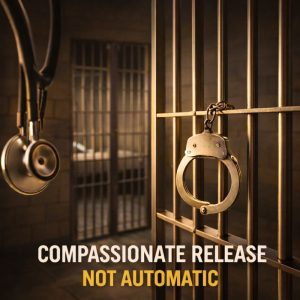 New Jersey’s Compassionate Release Act is supposed to do one thing well. It exists to ensure incarceration does not become a death sentence for someone who is seriously ill, medically vulnerable, or otherwise unable to be safely housed. The New Jersey Supreme Court’s decision in State v. Celestine Payne is a reminder, though, that medical eligibility is not the end of the analysis. Even when a person meets the statute’s medical requirements and shows low public safety risk, release remains discretionary. The State can still defeat the motion if it proves extraordinary aggravating circumstances.
Payne is not a close call on facts. The opinion recounts a disturbing pattern of calculated violence tied to a broader scheme involving life-insurance fraud, manipulation of family and friends, and multiple acts of violence, including an attempted murder and two murders. The Court highlighted the planning, the use of people around her, and the brutality of what happened, including the allegation that, after one victim survived, Payne went to the hospital, posed as his mother, and signed a do-not-resuscitate order. The point was not to relitigate guilt. The point was to explain why the State argued this case fell into the narrow category of truly exceptional and rare conduct.
What made the decision legally important is the procedural posture. The trial court found Payne met the Act’s medical and public safety requirements, but still denied release based on what the Supreme Court previously recognized as an extraordinary aggravating factor. The trial court concluded the offense involved conduct that was particularly heinous, cruel, or depraved. The Appellate Division reversed, reasoning that the facts did not meaningfully exceed what courts often see in murder prosecutions. The Supreme Court disagreed and reinstated the denial.
 The New Jersey Supreme Court has continued to reinforce the strength of our State Constitution’s warrant protections in its recent decision, State v. Fenimore. The Court unanimously held that the automobile exception does not permit police to conduct a warrantless search of a vehicle once law enforcement has full control over the car, its occupants, and the surrounding environment. In Fenimore, the defendant had been arrested for DWI inside a State Police barracks, the passenger had been removed, officers had possession of the keys, and the vehicle was required to be held for a mandatory twelve-hour impound period under John’s Law. Despite these circumstances, where mobility, safety concerns, and the risk of evidence destruction were completely neutralized, the State Police searched the car in the station parking lot without obtaining a warrant.
 In a landmark decision, the New Jersey Supreme Court weighed in on a crucial issue of first impression: Must a criminal defendant be provided in-person interpreting services during a jury trial, or will video remote interpreting (VRI) suffice? The case of State v. Juracan-Juracan dives into this question, addressing a major point of contention within the legal community—especially given the significant adjustments courts have had to make in response to the COVID-19 pandemic.