 Hudson County Criminal Lawyer Blog


 Search warrant cases often turn on major constitutional questions, but sometimes they come down to something much simpler: whether the State got the basics right on the face of the application. In a published decision issued on March 5, 2026, State of New Jersey v. Carlene Harris and Norman A. Thomas 4th, the New Jersey Appellate Division made clear that courts will not rescue a defective warrant by rewriting it after the fact. In this case, the warrant certification listed the key investigative events with dates that made the information stale, and the State later argued those dates were merely typographical errors. The Appellate Division rejected that argument, holding that probable cause must be evaluated from the four corners of the application itself, not from explanations offered later once the defect is exposed.
The case arose out of a drug investigation in Lakewood. According to the certification submitted in support of the search warrants, officers met with a confidential informant during the week of January 29, 2022, and then conducted controlled buys during the weeks of February 19, 2022, and February 26, 2022. Based on those events, police sought warrants in March 2023 to search two apartments, a vehicle, and a person. But the problem was obvious: if the dates in the certification were taken at face value, the key investigative activity had taken place more than a year earlier, making the information stale for probable cause purposes.
The State argued that the year “2022” was simply a typographical error and that the events actually happened in 2023. It also tried to support that position with police reports submitted later and asked for the opportunity to prove the mistake at a hearing. The trial court rejected that approach, suppressed the evidence, and the Appellate Division affirmed. The panel held that the validity of the warrants had to be judged based on what was actually presented to the issuing judge, not on what the State later wished had been included.
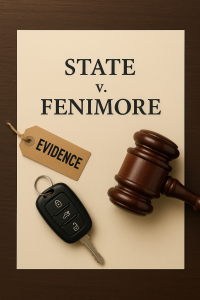 The New Jersey Supreme Court has continued to reinforce the strength of our State Constitution’s warrant protections in its recent decision, State v. Fenimore. The Court unanimously held that the automobile exception does not permit police to conduct a warrantless search of a vehicle once law enforcement has full control over the car, its occupants, and the surrounding environment. In Fenimore, the defendant had been arrested for DWI inside a State Police barracks, the passenger had been removed, officers had possession of the keys, and the vehicle was required to be held for a mandatory twelve-hour impound period under John’s Law. Despite these circumstances, where mobility, safety concerns, and the risk of evidence destruction were completely neutralized, the State Police searched the car in the station parking lot without obtaining a warrant.
 The United States Supreme Court determined in Maryland v. Buie that a protective sweep made during an in-home arrest is only justified when (1) officers can, as a precaution, search areas immediately adjoining the area of arrest if they are areas from which an attack can be immediately launched, and (2) officers can look beyond those adjoining spaces if that search is based on articulable facts that would make reasonably prudent officer believe there is a threat.